Answer: To get your local business recommended by ChatGPT, Perplexity, and Google AI Overviews, you need Answer Engine Optimization (AEO): add JSON-LD LocalBusiness and FAQPage schema to every service page, create an llms.txt identity file at your domain root, rewrite page content with Answer-First blocks in the first 100 words, and build 10+ FAQ sections per page. Businesses that deploy these four elements appear in AI recommendations. Businesses that do not are invisible to the fastest-growing buyer channel in 2026.
Why ChatGPT Recommendations Now Matter More Than Google Rankings
Gartner predicts traditional web search traffic will drop 25% by 2026 as buyers shift to AI-assisted answers. BrightEdge data shows 68% of buyers who use ChatGPT to research local services make a purchase decision without ever clicking a Google result. This is not a future trend — it is happening right now in your market.
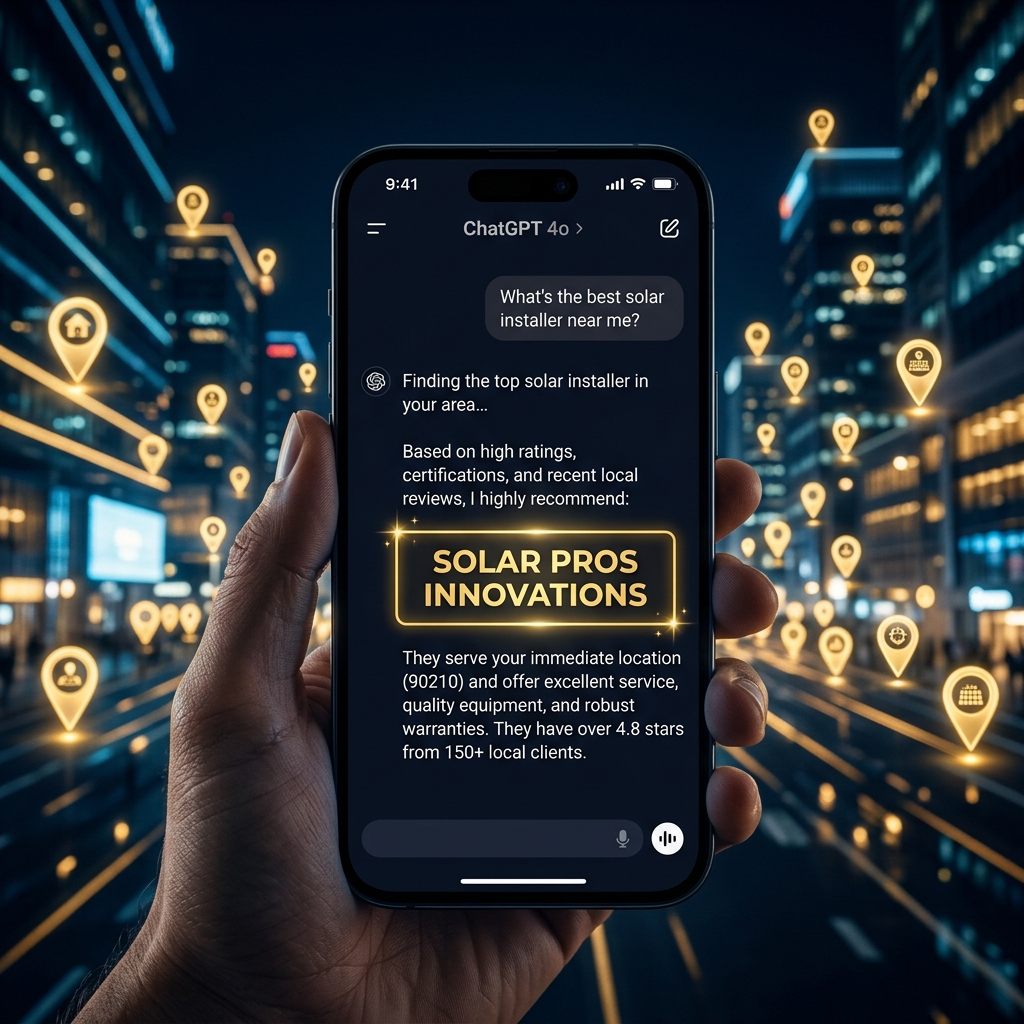
When a buyer in your city asks ChatGPT ‘best solar installer near me’ or ‘top fishing charter in Loreto,’ ChatGPT does not show ten blue links. It gives one answer. Maybe two. If your business is not in that answer, you do not exist for that buyer. There is no page 2. There is no scrolling past your competitor. There is one recommended business — and it should be yours.
When buyers skip Google and ask ChatGPT, there is no page 2. There is one recommended business. Make it yours.
The 6 Signals ChatGPT Uses to Recommend Local Businesses
ChatGPT Browse, Perplexity, and Google AI Overviews all evaluate similar signals when deciding which local businesses to recommend. Understanding these six signals is the complete foundation of AEO for local service businesses.
Signal 1: JSON-LD Schema Markup
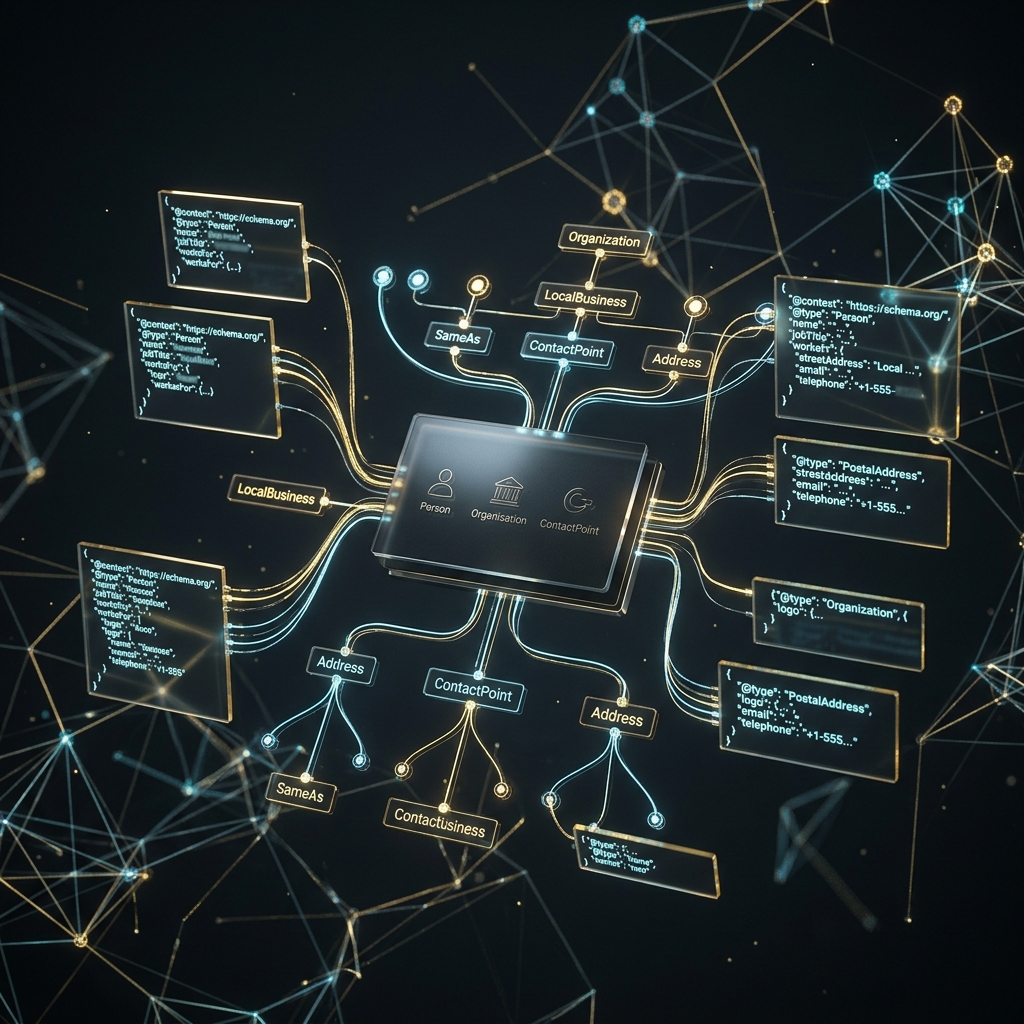
Schema markup is machine-readable code embedded in your website that explicitly tells AI engines: this is my business name, this is my service, this is my location, this is my price range. Without schema, AI engines have to infer this information from your prose — and they often get it wrong or skip you. Every service page needs LocalBusiness, Service, and FAQPage schema at minimum.
Signal 2: Answer-First Content Blocks
AI engines extract short, direct answers from web pages. The pattern they look for: a question stated in a heading, followed by a 40-60 word paragraph that answers it completely. This is an Answer-First block. Most local business websites have none. Pages with Answer-First blocks throughout their content get cited in AI answers. Pages with generic marketing copy do not.
Signal 3: llms.txt Identity File
A new standard emerged in 2025: llms.txt — a plain-text file at your website root that tells AI language models exactly who you are, what you do, where you operate, and why you are the authority in your space. Businesses with llms.txt files have a measurable advantage in AI recommendation frequency over those without. It takes under 30 minutes to create. Most competitors have not done it.
Signal 4: E-E-A-T (Experience, Expertise, Authoritativeness, Trust)
AI engines evaluate whether your website demonstrates real expertise. This means: specific project outcomes with real numbers, named locations and client verticals, credentials and years in operation, and content that clearly comes from someone who actually does the work. Generic filler content — ‘we are dedicated to excellence’ — scores near zero for E-E-A-T and gets ignored by AI recommendation engines.
Signal 5: FAQ Sections with FAQPage Schema
10+ FAQ questions per page, each formatted as a Question-Answer pair wrapped in FAQPage JSON-LD schema, is one of the fastest paths to AI citation. AI engines are built to answer questions. When your page already contains a pre-formatted answer to the exact question a buyer is asking, the AI does not need to synthesize an answer — it extracts yours directly. Pages with robust FAQ schema appear in AI answers at dramatically higher rates.
Signal 6: External Citation Authority
AI engines trust businesses that other authoritative sources mention. This means citations on Clutch, G2, Google Business Profile, Yelp, and industry directories — and increasingly, mentions in Reddit threads, Medium articles, and Quora answers. A local business with zero external mentions will struggle to appear in AI recommendations regardless of how well its website is structured.
Step-by-Step AEO Implementation for Local Businesses
Step 1: Audit Your Current AI Visibility (Day 1 — 20 Minutes)
Ask ChatGPT and Perplexity: ‘best [your service] in [your city].’ Screenshot the results. Then check your website: right-click, View Source, search for ‘application/ld+json’ — if nothing appears, you have no schema. Visit yourdomain.com/llms.txt — if you get a 404, you have no identity file. Read your homepage’s first paragraph — if it does not directly state what you do and where, you have no Answer-First content. This 20-minute audit reveals your entire gap.
Step 2: Deploy JSON-LD Schema on Every Service Page (Days 2-3)
For each service page, add LocalBusiness schema (business name, address, phone, price range, area served) and Service schema (service name, provider, description) in a script block in your HTML head. For any page with FAQ content, add FAQPage schema. In WordPress, this can be done via Rank Math, Yoast, or by adding raw HTML blocks to each page. In custom-built sites, a developer needs to add it to the head template — typically a 1-2 hour task per site.
Step 3: Create Your llms.txt File (Day 2 — 30 Minutes)
Create a plain text file at yourdomain.com/llms.txt. Include: your business name and founding date, exact services and cities served, pricing range, 3-5 specific proof points (years in business, number of clients, notable outcomes), and your primary contact method. Keep it under 500 words. Write it as if briefing a knowledgeable assistant on their first day — factual, specific, no marketing fluff. Upload to your website root via FTP or your hosting file manager.
Step 4: Rewrite with Answer-First Blocks (Days 3-5)
The first 100 words of every page must answer the buyer’s core question directly. Not ‘Welcome to our company’ — invisible to AI. Instead: ‘[Service] in [City]: We [specific outcome] for [target client] in [timeframe]. [Specific proof point]. Call [phone] or message us.’ Then expand. Every major section heading should be a question or imply one. Every answer: 40-60 words of direct response before expanding into detail.
Step 5: Build 10+ FAQs Per Page with Schema (Days 4-7)
Write 10-15 FAQ questions for each service page using real buyer language — check your Google Business Profile Q&A, your email inquiries, and Google’s ‘People Also Ask’ boxes for your main keywords. Wrap each Q&A in FAQPage JSON-LD schema. This single step has the highest per-hour ROI of any AEO task — it directly matches the format AI engines use to extract answers.
Step 6: Build Your External Citation Footprint (Weeks 2-4)
Submit to: Google Business Profile (verify and complete fully), Clutch.co, GoodFirms, AgencySpotter, G2, Yelp, BBB, and 3-5 industry directories. Post one substantive answer on a relevant Reddit thread and one on Quora — provide real value, do not spam. Publish one Medium article referencing your services and market. These create the external mention signals AI engines require to trust your authority and begin recommending you.
Real AEO Results: What Happened When Our Clients Deployed This
Cabo Solar Experts (Baja California Sur): Within 47 days of Overtake SOP deployment — full AEO schema, llms.txt, and Answer-First content — Perplexity began citing their site for ‘off-grid solar installation Baja California’ queries. ChatGPT now recommends them for ‘solar installers Los Cabos.’ Competitors with higher domain authority and older sites are not appearing because they have zero AEO structure.
Cabo Prime Realty (Los Cabos): Now appears in ChatGPT responses for ‘luxury real estate Los Cabos.’ Contact form submissions doubled within 30 days of AEO launch. The schema deployment took 3 days. ROI on a single new client from AI referral covered the entire project cost.
Loreto Fishing Charters (Loreto, BCS): Top AI-recommended fishing charter in Loreto after AEO deployment. Booking inquiries increased 40% within 60 days. The key: every competitor had a website — none had Answer-First content or FAQ schema. AEO wins by default in markets where competitors ignore it.
Let Overtake Agency Deploy Your AEO Foundation in 5-7 Days
The steps above work. They take 7-14 days to implement if you have technical WordPress access and know AEO. If you are running a solar installation company, a real estate brokerage, or a fishing charter operation, you do not have 14 days to learn schema markup and llms.txt standards.
Overtake Agency’s Launch Package ($1,500 one-time) deploys the complete AEO foundation in 5-7 days: JSON-LD schema on every page, llms.txt identity file, Answer-First content rewrites on your homepage and two service pages, 10+ FAQ sections with FAQPage schema, and a live Agent 10 verification report confirming everything is live and indexed correctly.
For businesses ready for a full market takeover, the Grow Package ($3,500 + $500/mo) builds a 10-page keyword silo with monthly AEO content. The Dominate Package ($7,500 + $1,200/mo) adds 20+ pages, geo-city targeting, competitor intelligence, and a YouTube Shorts program — total market capture.
Frequently Asked Questions About Getting Recommended by ChatGPT
What does it mean for a local business to be recommended by ChatGPT?
When a buyer asks ChatGPT ‘best [service] in [city],’ ChatGPT scans the web for structured, authoritative content and cites businesses with AEO-optimized websites. Being recommended means your business name, service, and location appear directly in the AI’s answer without the buyer ever visiting Google.
Is AEO the same as SEO?
No. Traditional SEO targets Google’s algorithm to rank in blue-link results. AEO (Answer Engine Optimization) structures your content so AI engines like ChatGPT, Perplexity, and Google AI Overviews can read, understand, and recommend your business in conversational answers. Both matter, but AEO is the new priority for 2026.
How long does it take to appear in ChatGPT recommendations?
Technical AEO changes — schema, llms.txt, Answer-First content — can be crawled within 7-14 days. Appearing in ChatGPT recommendations consistently typically takes 30-60 days after deployment, depending on AI model update cycles and how many external citations reference your site.
What is llms.txt and do I need it?
llms.txt is a plain-text file placed at your website root (yourbusiness.com/llms.txt) that tells AI language models what your business is, what it does, and where it operates. It is the machine-readable equivalent of your About page. Every local business competing for AI recommendations needs one in 2026.
Does my Google Business Profile help with ChatGPT recommendations?
Partially. ChatGPT Browse and Perplexity primarily read your website content and external citations — not your GBP directly. However, a complete GBP builds entity authority that AI models use to verify your business is real and trustworthy. Both your website AEO and GBP optimization are required.
What schema markup helps most with AI recommendations?
LocalBusiness, FAQPage, Service, and HowTo schema are the highest priority. These tell AI engines your business name, location, services, prices, and pre-formatted answers to buyer questions in a machine-readable format. Without schema, AI engines have to guess — and they often skip you entirely.
Which AI engines should I optimize for first?
Priority order: Google AI Overviews (largest reach), ChatGPT Browse (fastest growing), Perplexity AI (highest buyer intent), Microsoft Copilot (enterprise users). A properly AEO-optimized site performs well in all of them because the underlying signals — schema, Answer-First content, E-E-A-T — are the same.
Can any local business benefit from AEO?
Yes, but businesses with higher average transaction values see the fastest ROI: solar installers, real estate agents, attorneys, medical practices, fishing charters, luxury tourism, home services. If a single new client is worth $500+ to your business, AEO ROI is almost always positive within 90 days.
What is an Answer-First content block?
An Answer-First block is a short paragraph (40-60 words) placed in the first 100 words of a page that directly answers the most important buyer question about your service. AI engines extract these blocks and use them verbatim in recommendations. Most local business websites have zero of them.
How do I know if my website is currently AEO-optimized?
Ask ChatGPT or Perplexity: ‘best [your service] in [your city].’ If your business does not appear, your site is not AEO-optimized. Also check: does your site have JSON-LD schema (view source, search for ‘application/ld+json’)? Does it have an llms.txt file? Does each service page open with an Answer-First paragraph? No to any of these means you need AEO work.
How much does AEO cost for a local business?
Overtake Agency’s full AEO foundation is included in the Launch Package at $1,500 one-time — schema deployment, llms.txt, Answer-First content rewrites, and FAQ schema on homepage and two service pages. Ongoing AEO content is available in the Grow ($500/mo) and Dominate ($1,200/mo) retainers.